
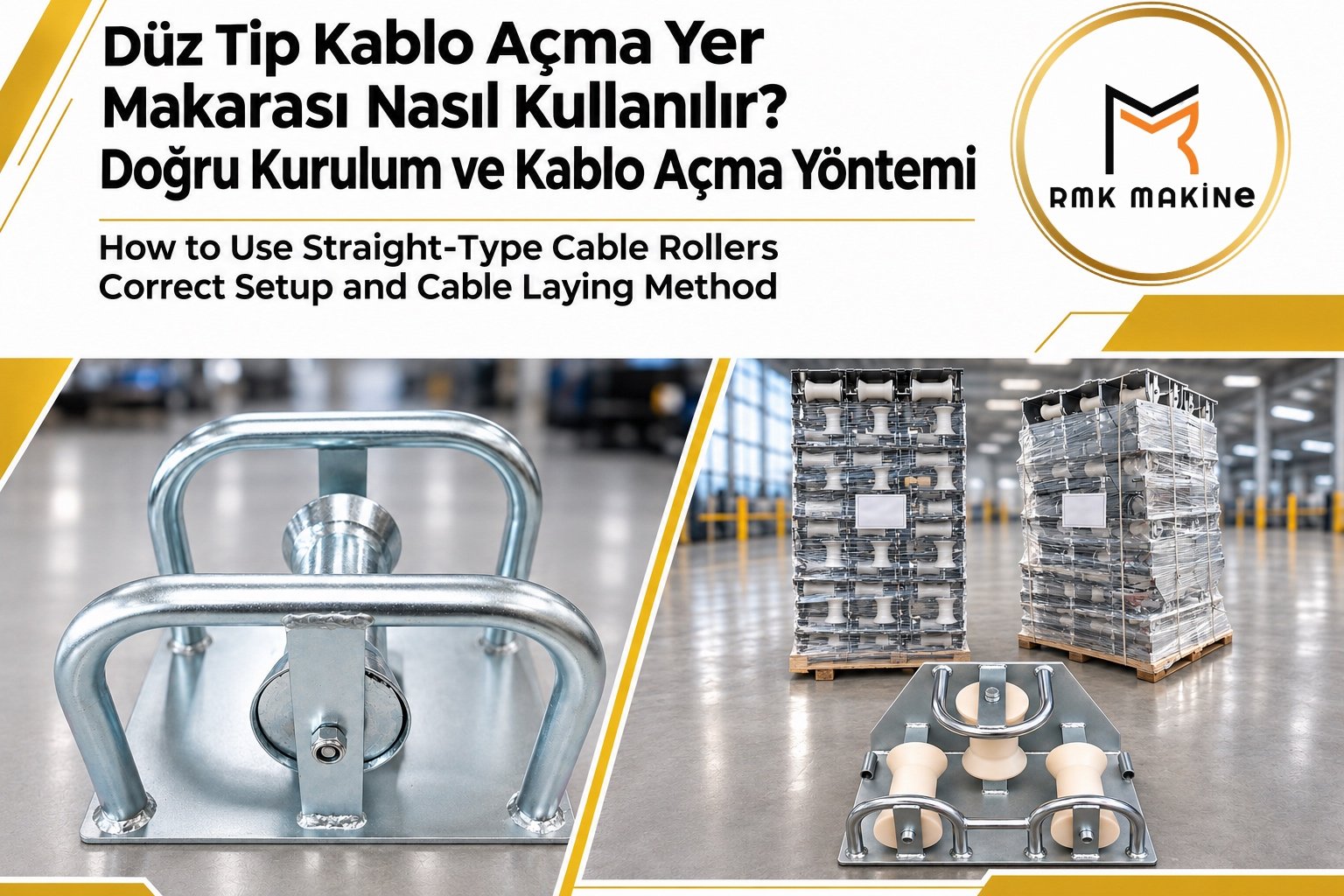
Düz Tip Kablo Açma Yer Makarası Nasıl Kullanılır? Doğru Kurulum ve Kablo Açma Yöntemi
Düz tip kablo açma yer makarası, bobin üzerindeki kabloyu zemine indirmeden, azami kablo çapı 160 mm’ye kadar olan enerji ve haberleşme kablolarını kontrollü şekilde açmaya yarayan sac veya boru ayaklı bir saha ekipmanıdır. Avrupa’ya ihracat yapan üreticiler, 20 Ocak 2027’de tam yürürlüğe girecek (AB) 2023/1230 sayılı Makine Tüzüğü’ne hazırlık olarak CE uyumlu, tam galvanizli gövdeli makaralara yöneliyor. Doğru ayak tipi ve makara malzemesi seçildiğinde kablo zarar görmeden, sürtünme ve bükülme en aza indirilerek açılır.
DÜZ TİP KABLO AÇMA YER MAKARASI NE İŞE YARAR?
Düz tip yer makarası, kablo bobinini zeminden yükseltip serbestçe döndürerek kablonun çekme hattına düz bir çizgide girmesini sağlar. Bobin doğrudan toprağa bırakılırsa kablo zarfı çizilir ve izolasyon zarar görür, bu yüzden yer altı kablo döşeme işlerinde makara kullanımı yaygın bir saha pratiğidir. Örneğin bir GES sahasında 500 metrelik bir OG kablo bobini açılırken, makara olmadan bobin kendi ekseninde kaymaya başlar ve kablo gerginliği dengesiz dağılır.
Makara, bobin milini iki ayak arasında sabit tutarak bu kaymayı önler. Saha ekibi kabloyu elle veya kablo çekme makinesiyle çekerken, bobin yalnızca ihtiyaç kadar döner ve fazla kablo yerde birikmez.
Makara olmadan bobin doğrudan zemine konursa, kablo kendi ağırlığıyla alt sarımlarda ezilme ve bükülme yarıçapı ihlali riski taşır. Bir elektrik taahhüt firmasının orta gerilim kablosu açtığı bir projede, bobin zeminde sabit durmadığı için kablo bir süre eğri açılmış ve ek kutusu bağlantısında zorlanma yaşanmıştı. Yer makarası, bobini zeminden izole ederek bu tür tekrarlayan saha sorunlarının önüne geçer.
DÜZ TİP YER MAKARASI SAHADA NASIL KURULUR VE KABLO NASIL AÇILIR?
Kurulum üç adımdır. Bobin, genellikle bir kablo makarası taşıma römorku ile saha girişine getirilir, makara ayakları bobin milinin iki ucuna yerleştirilir ve mil, makaraların oturduğu yuvaya geçirilir.
Diyelim ki saha şefi, dar bir kanal kazısının yanına bobini konumlandırıyor. Ayaklar arasındaki mesafe bobin genişliğine göre ayarlanmalıdır, makaralar milin üzerinde serbestçe dönmeli ve mil ile makara arasında sıkışma olmamalıdır. Kablo açılırken bobin üzerindeki ok işareti her zaman çekme yönünü gösterir, bobin ters yönde açılırsa sarım gevşer ve kablo kendi üzerine dolanabilir.
Kurulumdan sonra, çekmeye başlamadan önce bobinin elle hafifçe döndürülüp serbestçe hareket ettiğinin doğrulanması önerilir. Mil üzerinde sürtünme hissediliyorsa ayaklar yeniden hizalanmalı, aksi halde çekme makinesi sabit bir dirençle karşılaşır ve kablo üzerindeki gerilim beklenenden fazla olur.
SAC AYAKLI MI BORU AYAKLI MI? HANGİSİ HANGİ ZEMİNE UYGUN?
Boru ayaklı gövde daha hafiftir ve taşınabilir kurulumlarda tercih edilir, sac ayaklı gövde ise daha geniş tabanıyla eğimli veya düzensiz zeminde dengeyi korur. Bir trafo odasının önündeki dar koridorda boru ayaklı model işi kolaylaştırır, açık şantiye alanında ise sac ayaklı model daha kararlı durur.
| Özellik | Boru Ayaklı (RMK-DTM01) | Sac Ayaklı (RMK-DTM02) |
|---|---|---|
| Azami kablo çapı | 160 mm | 160 mm |
| Uzunluk | 300 mm | 300 mm |
| Genişlik | 200 mm | 280 mm |
| Yükseklik | 245 mm | 250 mm |
| Ağırlık | 4,6 kg | 5 kg |
| Makara malzemesi | Delrin, poliüretan veya metal | Delrin, poliüretan veya metal |
| Gövde kaplama | Tam galvanizli | Tam galvanizli |
Gövde tipine göre ağırlık farkı
Köşe tipi makaranın karşılıklı iki makarayı birlikte taşıması, ağırlığının düz tip modellerin iki katından fazlasına çıkmasının temel nedenidir. Saha ekibi makarayı elle taşıyacaksa bu fark, hangi modelin seçileceğini doğrudan belirler.
MAKARA MALZEMESİ (DELRİN, POLİÜRETAN, METAL) KABLO AÇMAYI NASIL ETKİLER?
Makara malzemesi, kablonun dış kılıfıyla sürtünme derecesini belirler. Beyaz delrin düşük sürtünme katsayısıyla hassas kılıflı fiber optik ve kontrol kablolarında kılıf çizilmesini azaltır, siyah poliüretan ise ağır enerji kablolarında darbe ve aşınmaya karşı daha dayanıklıdır.
Bir telekom saha ekibi fiber kablo açarken delrin makaralı modeli, bir enerji taahhüt firması ise OG kablo açarken poliüretan veya metal makaralı modeli tercih eder. Metal makara en yüksek yük kapasitesine sahiptir ama kılıfı yumuşak kablolarda çizebilir, bu yüzden makara malzemesi kablo tipine göre seçilmelidir.
DÜZ TİP MAKARA İLE KÖŞE TİPİ MAKARA NE ZAMAN BİRLİKTE KULLANILIR?
Hat doğrusal uzandığında düz tip yeterlidir, hat yön değiştirdiğinde köşe tipi makara devreye girer. Örneğin kablo kanalı bir bina köşesinden dönüyorsa, düz hat boyunca düz tip makaralar dizilir ve köşeye köşe tipi makara eklenir, böylece kablo dönüşte sürtünmeden ve keskin bükülmeden geçer.
Köşe tipi makaranın gövdesi, karşılıklı iki makarayı birlikte taşıdığı için düz tipten daha ağır ve daha geniş gelir. Saha planı yapılırken hat üzerindeki her yön değişikliğine bir köşe tipi makara, aralardaki düz kesimlere ise düz tip makara hesaplanmalıdır.
KABLO AÇARKEN EN SIK YAPILAN HATALAR NELERDİR?
En sık hata, makara ayaklarının bobin genişliğine göre ayarlanmadan kurulmasıdır, bu durumda bobin mil üzerinde yana kayar ve kablo makaradan taşar. İkinci hata, ok işaretinin yönüne bakılmadan bobinin ters açılmasıdır, bu da kablonun kendi üzerine sarılıp hasar görmesine yol açar.
Bir saha ekibinde gözlenen üçüncü hata, azami kablo çapı 160 mm olan bir makaraya daha kalın bir OG kablosunun yerleştirilmesidir, bu durumda kablo makaradan taşar ve zeminle sürtünür. Kablo açma işlemleri eğitimli personel tarafından ve iş güvenliği talimatlarına uygun şekilde yürütülmelidir, bobin dönerken ellerin makara ile mil arasına girmemesine özellikle dikkat edilmelidir.
Dördüncü bir hata, iş günü sonunda yarım açılmış bobinin makarada sabitlenmeden bırakılmasıdır. Rüzgarlı veya eğimli bir sahada sabit olmayan bobin kendiliğinden dönebilir, ertesi gün ekip işe başladığında kablo zeminde gevşek ve dolanmış bulunabilir. Vardiya sonunda bobinin mil kilidinin kontrol edilmesi bu kaybı önler.
SIK SORULAN SORULAR
Düz tip yer makarası hangi kablo çaplarına uygundur?
RMK’nın düz tip boru ve sac ayaklı modelleri 160 mm’ye kadar kablo çapını taşır. Bu ölçü çoğu orta gerilim enerji kablosu ile fiber optik ve kontrol kablolarını kapsar. Daha kalın özel kesitli kablolarda makara seçimi önceden ürün sayfasından teyit edilmelidir, aksi halde kablo makaradan taşıp zeminle sürtünebilir.
Sac ayaklı ve boru ayaklı makara arasındaki temel fark nedir?
Sac ayaklı model 280 mm genişliğinde ve 5 kg ağırlığında daha geniş bir tabana sahiptir, düzensiz veya eğimli zeminde dengeyi korur. Boru ayaklı model 200 mm genişliğinde ve 4,6 kg ile daha hafif bir çözüm sunar, dar alanlarda ve sık taşınan işlerde tercih edilir.
Makara malzemesi nasıl seçilir?
Hassas kılıflı fiber optik ve kontrol kablolarında beyaz delrin düşük sürtünmesiyle kılıfı korur. Ağır enerji kablolarında siyah poliüretan darbe ve aşınmaya karşı dayanıklıdır. Metal makara en yüksek yük kapasitesini sunar ama yumuşak kılıflı kablolarda çizilme riski taşır, bu yüzden kablo tipine göre seçilmelidir.
Köşe tipi makaraya ne zaman ihtiyaç duyulur?
Kablo hattı düz uzanmıyorsa, bir köşeden veya bina kenarından dönüyorsa köşe tipi makaraya ihtiyaç vardır. Düz tip makaralar hattın doğrusal kesimlerinde kullanılır, yön değiştiren her noktada bir köşe tipi makara eklenerek kablonun keskin bükülmeden geçmesi sağlanır.
Düz tip yer makarası tek başına kablo çekme makinesinin yerini tutar mı?
Hayır. Yer makarası bobini sabit tutup serbestçe döndürerek kabloyu kontrollü açar, çekme kuvvetini ise kablo çekme makinesi veya elle çekme sağlar. İki ekipman birlikte çalışır, makara kabloyu korurken çekme makinesi hattı ilerletir.
Makara ayakları bobin genişliğine uymuyorsa ne olur?
Ayaklar bobin milinin genişliğine göre ayarlanmazsa bobin mil üzerinde yana kayar, kablo makaradan taşabilir ve zeminle sürtünerek izolasyonu zedeleyebilir. Kurulumdan önce ayak aralığı bobin genişliğine göre kontrol edilmeli ve mil üzerinde boşluk kalmamalıdır.
Galvanizli gövde dış mekan kullanımında fark yaratır mı?
Evet. Tam galvanizli kaplama, makarayı nem, yağmur ve toprak teması gibi dış mekan koşullarına karşı korur ve gövdenin paslanmasını geciktirir. Açık şantiye ve GES sahalarında uzun süre dışarıda bırakılan ekipmanlarda bu kaplama kullanım ömrünü doğrudan etkiler.
DÜZ TİP KABLO AÇMA YER MAKARASI KONTROL LİSTESİ
- Makara ayak aralığını bobin genişliğine göre ayarlayın, mil üzerinde boşluk veya sıkışma olmamalı.
- Bobinin açılma yönünü üzerindeki ok işaretinden doğrulayın.
- Kablo çapını makaranın azami 160 mm sınırıyla karşılaştırın.
- Kablo tipine göre makara malzemesini (delrin, poliüretan, metal) seçin.
- Hat üzerindeki yön değişikliklerinde köşe tipi makara eklemeyi saha planına dahil edin.
Kablo açma işlemleri, eğitimli saha personeli tarafından ve iş güvenliği kurallarına uygun şekilde yürütüldüğünde hem kablo hem de ekip güvende kalır.
RMK MAKİNE
Profesyonel Kablo Döşeme Ekipmanları
📞 WhatsApp / Telefon: (+90) 501 570 7383
✉️ E-posta: info@rmkmakine.com
🌐 Web Sitesi: www.rmkmakine.com
📸 Instagram: @rmk.makine
📘 Facebook: RMK Makine
[ENGLISH]
HOW TO USE A STRAIGHT-TYPE CABLE ROLLER? CORRECT SETUP AND CABLE UNWINDING METHOD
The straight-type cable roller is a sheet-steel or tube-legged field equipment unit that unwinds energy and communication cables with a maximum cable diameter of up to 160 mm from the drum in a controlled way, without lowering the cable to the ground. Manufacturers exporting to Europe are moving toward CE-compliant, fully galvanized-body rollers in preparation for Machinery Regulation (EU) 2023/1230, which comes into full effect on 20 January 2027. When the correct leg type and roller material are selected, the cable is unwound without damage, with friction and bending minimized.
WHAT IS THE STRAIGHT-TYPE CABLE ROLLER USED FOR?
The straight-type cable roller lifts the cable drum off the ground and lets it rotate freely, so the cable feeds into the pulling line in a straight path. If the drum is placed directly on the ground, the cable jacket gets scratched and the insulation is damaged, which is why using a roller is a common field practice in underground cable laying work. For example, when unwinding a 500 meter MV cable drum on a solar power plant site, without a roller the drum starts to shift on its own axis and the cable tension is distributed unevenly.
The roller prevents this shifting by holding the drum shaft fixed between two legs. While the site crew pulls the cable by hand or with a cable pulling machine, the drum rotates only as much as needed and excess cable does not pile up on the ground.
If the drum is placed directly on the ground without a roller, the cable carries a risk of crushing and bend radius violation in the lower windings under its own weight. On a project where an electrical contracting company was unwinding a medium voltage cable, the drum did not stay fixed on the ground, so the cable was unwound at an angle for a while and strain occurred at the joint box connection. The cable roller prevents this type of recurring field problem by isolating the drum from the ground.
HOW IS THE STRAIGHT-TYPE CABLE ROLLER SET UP ON SITE AND HOW IS THE CABLE UNWOUND?
Setup is three steps. The drum is typically brought to the site entrance with a cable drum trailer, the roller legs are placed at both ends of the drum shaft, and the shaft is fitted into the seat where the rollers sit.
Suppose the site supervisor positions the drum next to a narrow trench excavation. The distance between the legs must be adjusted to the drum width, the rollers must rotate freely on the shaft, and there must be no binding between the shaft and the roller. While the cable is unwound, the arrow mark on the drum always indicates the pulling direction, if the drum is unwound in the wrong direction the winding loosens and the cable can tangle around itself.
After setup, before starting to pull, it is recommended to rotate the drum lightly by hand to confirm it moves freely. If friction is felt on the shaft, the legs should be realigned, otherwise the pulling machine encounters constant resistance and the tension on the cable is higher than expected.
SHEET-STEEL LEGS OR TUBE LEGS? WHICH SUITS WHICH GROUND?
The tube-leg body is lighter and preferred for portable setups, while the sheet-steel leg body keeps its balance on sloped or uneven ground thanks to its wider base. In a narrow corridor in front of a transformer room, the tube-leg model makes the work easier, while on an open construction site the sheet-steel leg model stays more stable.
| Feature | Tube Legs (RMK-DTM01) | Sheet-Steel Legs (RMK-DTM02) |
|---|---|---|
| Maximum cable diameter | 160 mm | 160 mm |
| Length | 300 mm | 300 mm |
| Width | 200 mm | 280 mm |
| Height | 245 mm | 250 mm |
| Weight | 4.6 kg | 5 kg |
| Roller material | Delrin, polyurethane or metal | Delrin, polyurethane or metal |
| Body coating | Fully galvanized | Fully galvanized |
Weight difference by body type
The fact that the corner-type cable roller carries two opposing rollers together is the main reason its weight comes to more than double that of the straight-type models. If the site crew will carry the roller by hand, this difference directly determines which model is chosen.
HOW DOES ROLLER MATERIAL (DELRIN, POLYURETHANE, METAL) AFFECT CABLE UNWINDING?
The roller material determines the degree of friction with the cable’s outer jacket. White Delrin, with its low coefficient of friction, reduces jacket scratching on sensitive-jacketed fiber optic and control cables, while black polyurethane is more resistant to impact and wear on heavy power cables.
A telecom field crew prefers the Delrin-roller model when unwinding fiber cable, while an energy contracting company prefers the polyurethane or metal-roller model when unwinding MV cable. The metal roller has the highest load capacity but can scratch the jacket on soft cables, which is why the roller material should be chosen according to the cable type.
WHEN ARE STRAIGHT-TYPE AND CORNER-TYPE ROLLERS USED TOGETHER?
The straight-type is sufficient where the line runs in a straight path, and the corner-type roller comes into play where the line changes direction. For example, if the cable duct turns around the corner of a building, straight-type rollers are lined up along the straight section and a corner-type roller is added at the corner, so that the cable passes through the turn without friction and without a sharp bend.
Because the body of the corner-type roller carries two opposing rollers together, it comes out heavier and wider than the straight type. When planning the site layout, a corner-type roller should be allocated for every direction change on the line, and straight-type rollers for the straight sections in between.
WHAT ARE THE MOST COMMON MISTAKES WHEN UNWINDING CABLE?
The most common mistake is setting up the roller legs without adjusting them to the drum width, in which case the drum shifts sideways on the shaft and the cable spills off the roller. The second mistake is unwinding the drum in the wrong direction without checking the arrow mark, which causes the cable to wind around itself and get damaged.
A third mistake observed on a field crew is placing a thicker MV cable on a roller with a maximum cable diameter of 160 mm, in which case the cable spills off the roller and rubs against the ground. Cable unwinding operations must be carried out by trained personnel and in compliance with occupational safety instructions, with particular care taken to keep hands from getting caught between the roller and the shaft while the drum is rotating.
A fourth mistake is leaving a partially unwound drum on the roller at the end of the work day without securing it. On a windy or sloped site, an unsecured drum can start rotating on its own, and when the crew starts work the next day the cable may be found loose and tangled on the ground. Checking the shaft lock on the drum at the end of the shift prevents this loss.
FREQUENTLY ASKED QUESTIONS
What cable diameters does the straight-type roller support?
RMK’s straight-type tube-leg and sheet-steel-leg models carry cable diameters of up to 160 mm. This size covers most medium voltage power cables as well as fiber optic and control cables. For thicker, special-section cables, the roller selection should be confirmed in advance on the product page, otherwise the cable can spill off the roller and rub against the ground.
What is the main difference between sheet-steel-leg and tube-leg rollers?
The sheet-steel-leg model has a wider base at 280 mm width and 5 kg weight, keeping its balance on uneven or sloped ground. The tube-leg model offers a lighter solution at 200 mm width and 4.6 kg, preferred in narrow spaces and for jobs that are moved frequently.
How is roller material selected?
On sensitive-jacketed fiber optic and control cables, white Delrin protects the jacket with its low friction. On heavy power cables, black polyurethane is resistant to impact and wear. The metal roller offers the highest load capacity but carries a risk of scratching on soft-jacketed cables, so it should be selected according to the cable type.
When is a corner-type roller needed?
A corner-type roller is needed if the cable line does not run straight, if it turns around a corner or the edge of a building. Straight-type rollers are used on the straight sections of the line, and a corner-type roller is added at every point where the direction changes, ensuring the cable passes through without a sharp bend.
Does a straight-type cable roller alone replace a cable pulling machine?
No. The cable roller keeps the drum fixed and lets it rotate freely to unwind the cable in a controlled way, while the pulling force is provided by a cable pulling machine or manual pulling. The two pieces of equipment work together, with the roller protecting the cable while the pulling machine advances the line.
What happens if the roller legs do not match the drum width?
If the legs are not adjusted to the width of the drum shaft, the drum shifts sideways on the shaft, the cable can spill off the roller and rub against the ground, damaging the insulation. Before setup, the leg spacing should be checked against the drum width, and there should be no play left on the shaft.
Does a galvanized body make a difference for outdoor use?
Yes. The fully galvanized coating protects the roller against outdoor conditions such as moisture, rain and contact with soil, and delays corrosion of the body. For equipment left outdoors for long periods on open construction sites and solar power plant sites, this coating has a direct effect on service life.
STRAIGHT-TYPE CABLE ROLLER CHECKLIST
- Adjust the roller leg spacing to the drum width, there should be no play or binding on the shaft.
- Confirm the drum’s unwinding direction from the arrow mark on it.
- Compare the cable diameter against the roller’s maximum limit of 160 mm.
- Select the roller material (Delrin, polyurethane, metal) according to the cable type.
- Include adding a corner-type roller at direction changes on the line in the site plan.
When cable unwinding operations are carried out by trained field personnel and in compliance with occupational safety rules, both the cable and the crew stay safe.
CONTACT RMK MAKİNE
Professional Cable Laying Equipment
📞 WhatsApp / Phone: (+90) 501 570 7383
✉️ E-mail: info@rmkmakine.com
🌐 Website: www.rmkmakine.com
📸 Instagram: @rmk.makine
📘 Facebook: RMK Makine

 İletişim Bilgileri (7/24 Hizmet):